
Attribution Theory: Why We Explain Ourselves the Way We Do

A delegate finishes a role-play badly, a team misses a performance target, a new manager gives feedback that goes down like the proverbial lead balloon. What happens next depends less on the facts of the situation and more on the story the person constructs about why it happened.
Did they fail because they lack ability, or because they didn’t prepare enough?
Was the target missed because the team isn’t good enough, or because the process was broken?
Is the feedback poor because that manager is fundamentally unsuited to leadership, or because nobody ever showed them how?
These explanations are not neutral, and can determine whether someone tries again or gives up, whether a manager reaches for support or for a performance improvement plan, whether a team member leaves a session feeling motivated or hollow. Enter Attribution Theory, the study of how people construct causal explanations for outcomes.
This piece examines what the theory is, and what the evidence offers our practice. Some of it is solid, some of it has been substantially revised under scrutiny, and one of its most famous claims has been largely set aside.
Paid subscribers gain access to a fortnightly omnibus edition containing an additional five to six articles.
Where the theory comes from
Fritz Heider set out the foundations in his 1958 book The Psychology of Interpersonal Relations, proposing that people function as what he called “naïve scientists,” constructing systematic causal explanations for the behaviour they observe around them. His core distinction was between:
personal causality, outcomes driven by intention and ability,
and
impersonal causality, outcomes shaped by situational forces.
He also observed that people tend to over-credit personality and under-credit context when explaining others’ behaviour.
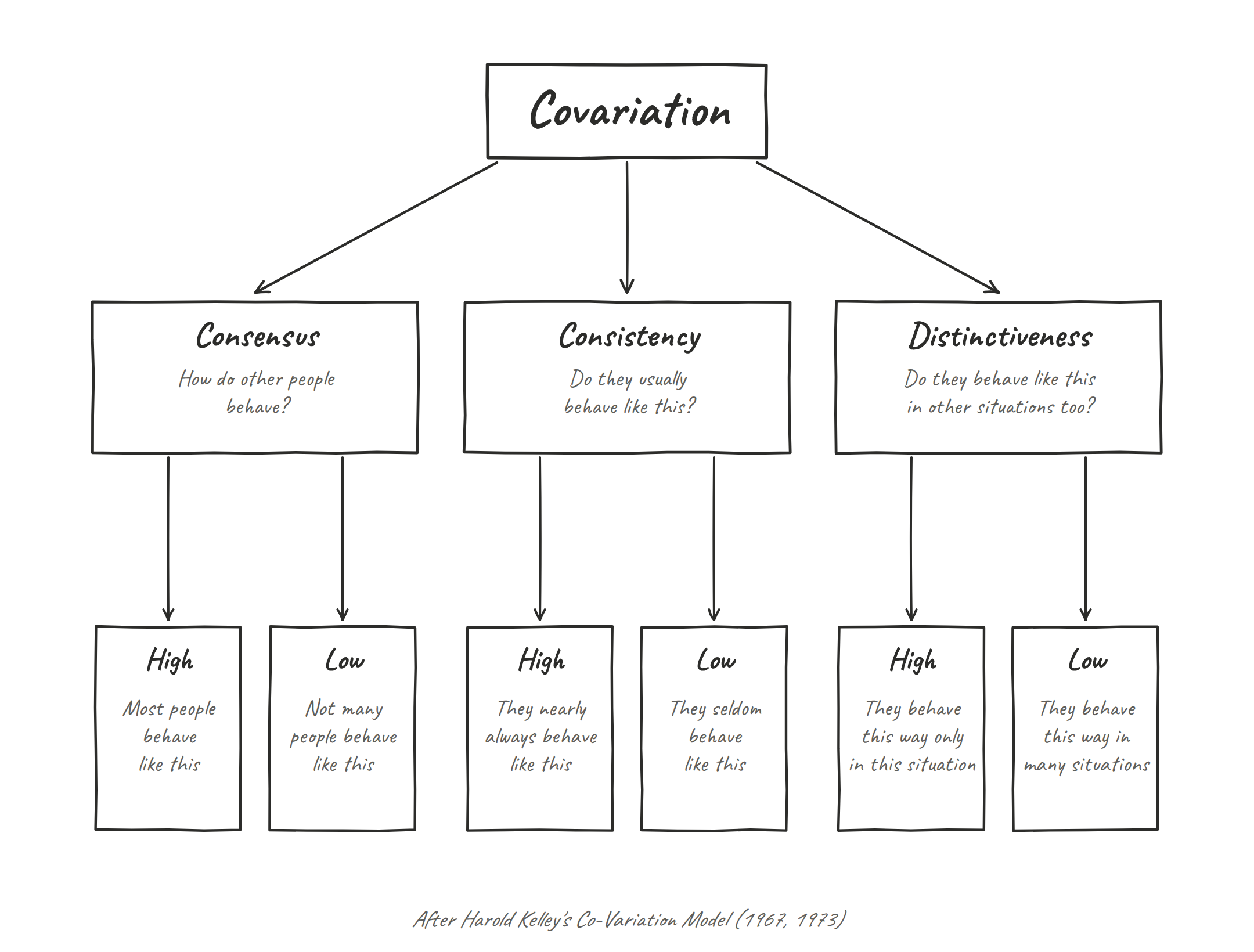
Harold Kelley formalised the attribution process in the late 1960s and early 1970s through his covariation model, describing how people use three types of information when assigning causes (Kelley, 1967, 1973).
Consensus asks whether other people respond to this situation in the same way.
Distinctiveness asks whether this person behaves differently in other situations.
Consistency asks whether this person always behaves this way in this situation.
Low consensus, low distinctiveness, and high consistency tend to produce person-level attributions (”it’s something about them”).
High consensus, high distinctiveness, and high consistency tend to produce situation-level attributions (”it’s something about the task or context”).
Kelley also introduced the discounting principle: when multiple plausible causes are present, people discount each one. This matters for feedback, which we’ll discuss later.
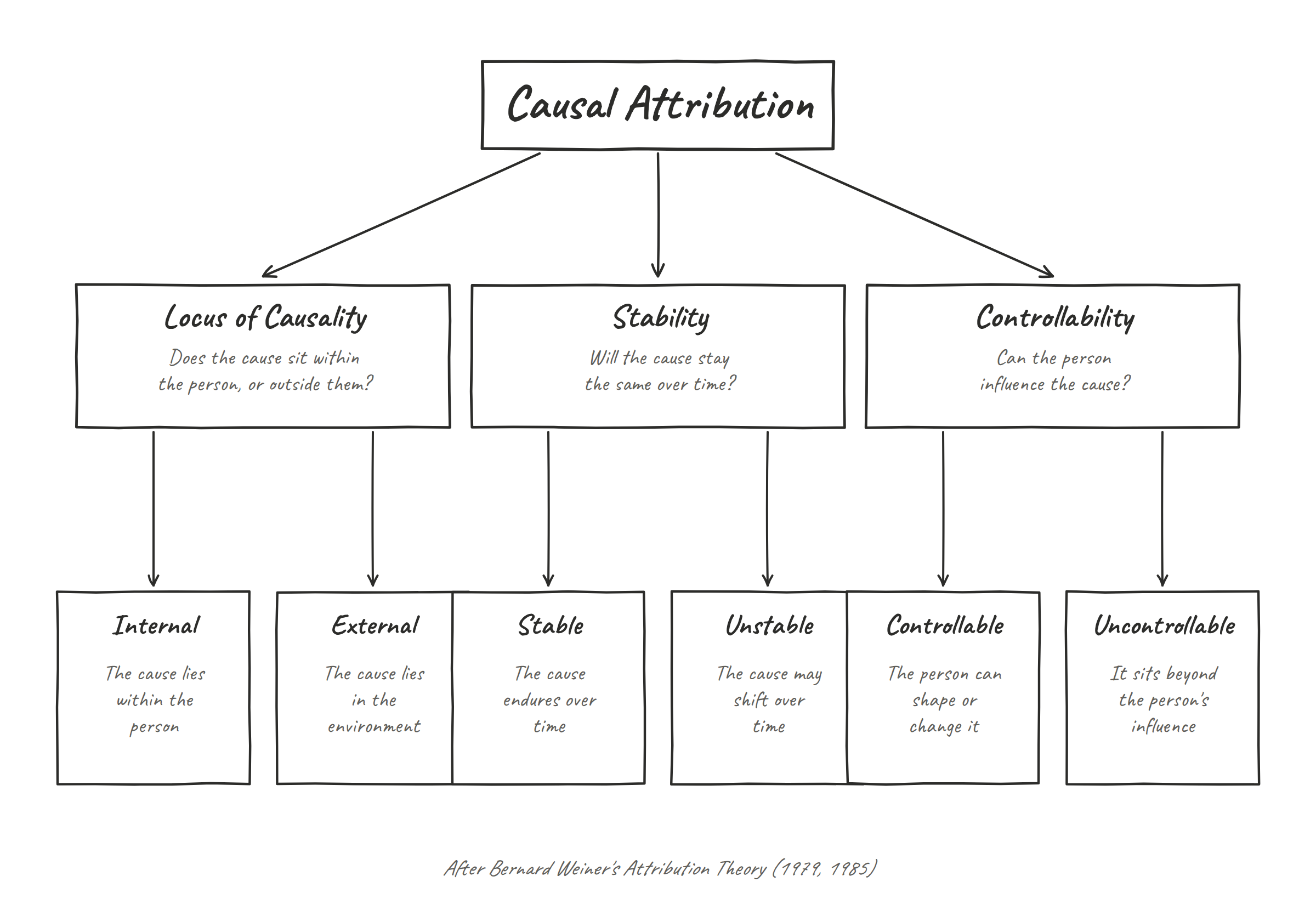
Bernard Weiner built the framework into his three-dimensional taxonomy for classifying attributions is the heart of the theory (Weiner, 1985; Weiner, 1986).
The first dimension is locus of causality, whether a cause is internal or external to the person.
The second is stability, whether a cause is stable over time or variable.
The third is controllability, whether the person can influence the cause or not.
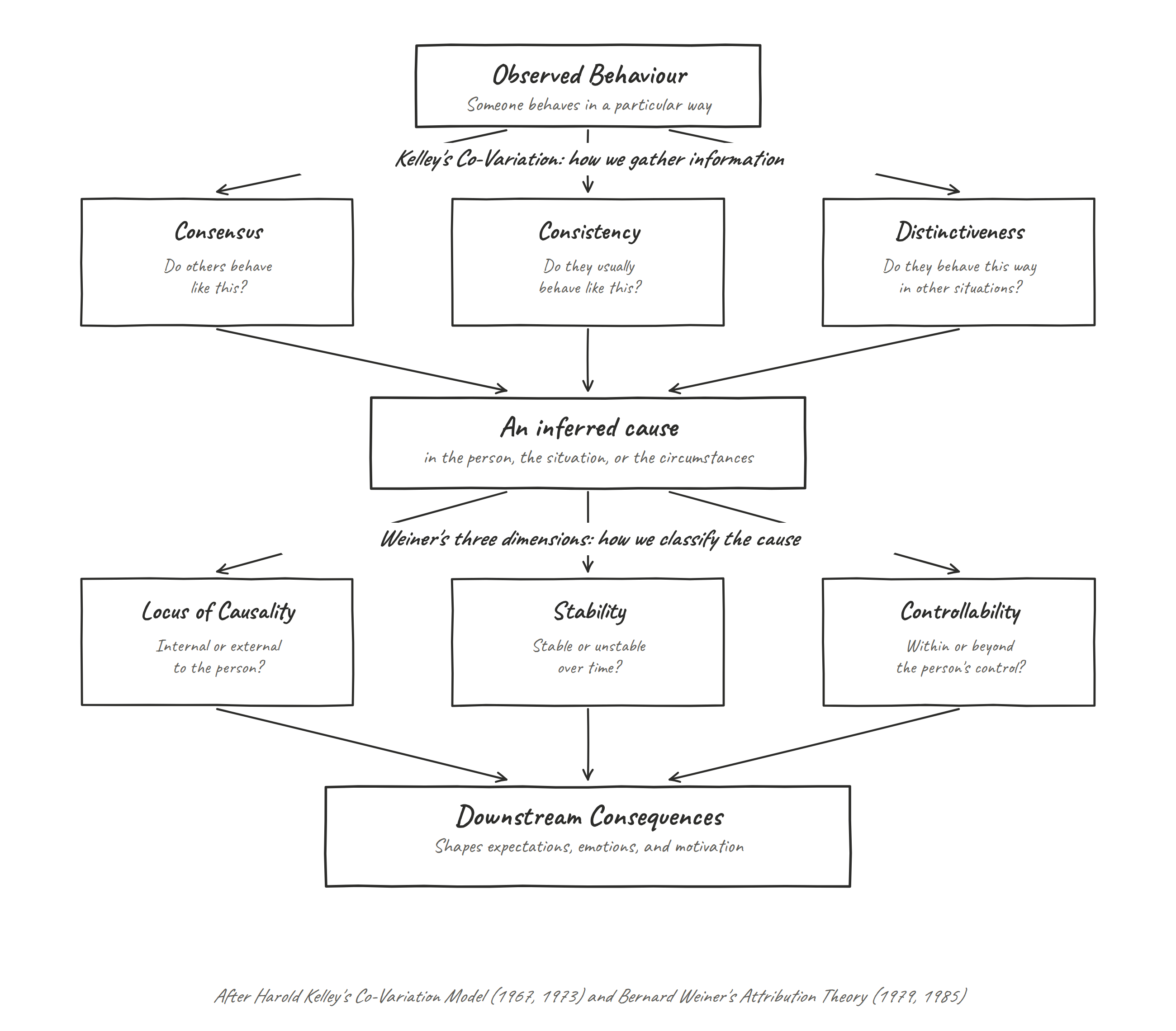
These dimensions interact to produce specific emotional and motivational consequences. Internal attributions for success produce pride; internal attributions for failure produce shame. Stable attributions for failure produce hopelessness and reduce future effort; unstable attributions maintain hope. Controllable causes of failure produce guilt and a desire to do something different; uncontrollable causes produce shame and withdrawal.
Two people can fail the same assessment and walk away with entirely different relationships to future effort, based entirely on how they explain to themselves what happened.
How well does the evidence hold up?
Note: This section is quite long, full of references, and a fair few numbers. If you would like to skip ahead to the next section where we start talking about practical implication and application, please feel free to. I wanted to make sure this section was included though as it highlights how, over time, scientists and researchers refine understanding and adjust theories to better explain the available evidence.
Weiner’s core attribution-emotion-action sequence is well-supported. Rudolph, Roesch, Greitemeyer, and Weiner (2004) conducted a meta-analysis of 64 studies covering more than 12,000 participants and found the pathway from causal attribution through emotion to behaviour highly consistent across cultures, sample characteristics, and decades of publication (Rudolph et al., 2004).
The self-serving bias, the tendency to attribute success to internal factors and failure to external ones, is similarly robust. Mezulis, Abramson, Hyde, and Hankin (2004) synthesised 266 studies with 503 effect sizes and found a large average effect, present in nearly all samples (Mezulis et al., 2004). The bias varies in meaningful ways: it is strongest in Western, individualist contexts, substantially weaker in East Asian collectivist cultures, and noticeably attenuated in people experiencing depression. Allen, Robson, Martin, and Laborde (2020) confirmed the bias across 69 studies and more than 10,000 athletes in sports contexts; sports psychology has developed some of the more practically-applied attribution work.
The manager attribution research is credible and meaningful in our work. Green and Mitchell (1979) demonstrated that leaders’ attributions for subordinate performance directly determine their supervisory response, with internal attributions for poor performance producing punitive reactions and external attributions producing supportive ones (Green and Mitchell, 1979). Ashkanasy and Gallois (1994) found that attributions accounted for between 23 and 51 percent of variance in how leaders evaluated their people (Ashkanasy and Gallois, 1994). How a line manager explains a member of their team’s underperformance shapes the entire response that follows, and that response has direct implications for what we can, and do do.
Kluger and DeNisi’s (1996) meta-analysis of 607 effect sizes found that more than one third of feedback interventions actually decreased performance (Kluger and DeNisi, 1996). Their explanation was that feedback effectiveness decreases as attention moves from the task toward the self. When feedback focuses on who someone is rather than what they did, it triggers self-evaluation processes rather than strategy-focused thinking, which maps directly onto Weiner’s dimensions: person-level feedback activates internal, stable, uncontrollable attributions; task-level feedback activates controllable, strategy-focused ones.
Now for the parts that do not hold up as well.
The Fundamental Attribution Error, named by Lee Ross in 1977, describes the tendency to overestimate dispositional factors and underestimate situational ones when explaining others’ behaviour (Ross, 1977). The original finding has been replicated, but cross-cultural research substantially qualifies how fundamental it actually is. Miller (1984) found that American children made increasingly dispositional attributions with age, while Hindu Indian children made increasingly situational ones, suggesting that cultural socialisation rather than universal cognition is driving the pattern (Miller, 1984). Choi, Nisbett, and Norenzayan (1999) concluded that East Asians do engage in dispositional thinking, but they are more willing to revise dispositional inferences when situational constraints are made salient (Choi, Nisbett and Norenzayan, 1999).
So the Attribution Error, or the tendency to over-estimate dispositional factors and underestimate situational ones, is not universal but may be present depending on the culture in which you are working.
Note: The above is a great example of how just because something can be proven within one set of data, does not mean it then lacks future nuance. It also raises the importance of being a rigorous and honest evidenced-informed practitioner. This means taking the research and data that we have and using it to inform our actions alongside our context-specific observations and professional experience and judgement. We must never become comfortable with outsourcing decision-making based on any one of these three factors and must instead work consistently to synthesise all of these inputs to make the best possible decision.
The actor-observer asymmetry is a cautionary tale for the field. For decades, the claim that actors explain their own behaviour situationally while observers explain the same behaviour dispositionally was treated as an established finding, appearing in textbooks and theoretical frameworks as reliable fact. Malle (2006) conducted a meta-analysis of 173 studies spanning 1971 to 2004 and found average effect sizes converging to zero after correcting for publication bias. The asymmetry held only for negative events and reversed for positive ones. No systematic review of this supposedly robust finding had existed before Malle’s analysis. A claim that shaped attribution theory for thirty years turned out to be largely an artefact of how the original studies were designed and reported.
Attribution retraining, the practical intervention designed to shift maladaptive explanatory patterns, has a moderate evidence base in educational contexts and a much thinner one in workplace settings. Perry and colleagues demonstrated that first-year university students receiving attribution retraining showed substantially lower failure rates than controls, and Lazowski and Hulleman (2016) found a moderate average effect size of d = 0.54 for attribution retraining on student motivation across studies. The problem is that most of this evidence comes from a single research programme at one university, the effects are strongest for students who are already struggling, and there are essentially no published randomised controlled trials in corporate or workplace settings. The mechanism is theoretically coherent, and the educational evidence is reasonably credible, but applying it to organisational practice is an extrapolation. A reasonable and informed extrapolation, but an extrapolation nonetheless.
Paid subscribers gain access to a fortnightly omnibus edition containing an additional five to six articles.
Isn’t this sounding a bit familar?
Growth mindset theory is, at its core, Attribution Theory with a rebrand and a more intuitive story. Dweck’s own earlier work with Diener (1978) and others drew explicitly on attributional patterns, documenting how children’s causal explanations predicted helpless versus mastery-oriented responses to setbacks. Her later framework mapped directly onto Weiner’s dimensions: a fixed mindset leads people to attribute failure to stable, uncontrollable ability, producing hopelessness; a growth mindset leads to attributions involving unstable, controllable factors like effort and strategy, producing persistence.
The problem, as we’ve previously examined, is that the evidence does not support what growth mindset became. Macnamara and Burgoyne (2023) found a small overall effect that was non-significant after correcting for publication bias across 63 studies and nearly 98,000 participants, with researchers holding financial incentives reporting significantly larger effects than independent researchers (Macnamara and Burgoyne, 2023). The highest-quality studies produced effects approaching zero. There is no credible workplace evidence base at all. Dweck’s 2015 observation that organisations were implementing “false growth mindset,” praising effort without teaching strategies or providing development support, is sometimes cited as a correction that keeps the theory intact. A more accurate reading is that it illustrates what happens when a commercial framework expands faster than its evidence: the theory gets retrofitted to explain the failures rather than revised in response to them.
Attribution theory offers the more precise framework because it is built on the more robust research base. Growth mindset borrowed the attributional mechanism, simplified it into a binary, attached it to a compelling narrative about potential, and scaled it into a training product that the research could not and still cannot support. Many in L&D, including myself for a time, ran with it, built programmes around it, and is now in the awkward position of having invested heavily in something the evidence largely does not justify.
So what does the evidence support?
The strongest practical guidance concerns how we frame feedback and how we train managers to think about performance.
Weiner’s dimensions give us a vocabulary for diagnosing what kind of feedback we are delivering. Feedback that implies internal, stable, uncontrollable causes (”you lack the natural ability for this”) will predictably produce shame, hopelessness, and reduced motivation. Feedback that implies internal, unstable, controllable causes (”your preparation for this wasn’t sufficient, and that’s something you can change”) preserves motivation and directs attention toward something the recipient can act on. This isn’t about being kinder in feedback. It’s about having a mechanism grounded in a well-evidenced framework that moves the receiver of feedback towards action.
Training managers on attribution awareness is one of the higher-leverage interventions the evidence supports. Based on Green and Mitchell’s (1979) work, managers should be equipped to slow down their attributional process before forming judgements about people’s performance. Kelley’s covariation framework, though impractical as a moment-to-moment cognitive procedure, provides a useful structured reflection tool:
Is this poor performance consistent across time?
Does it show up across different tasks and contexts, or only in this one?
Do others in the same situation show similar patterns?
These questions move a manager from “this person isn’t capable” toward “what is the environment doing, and what has this person been given?” That shift has direct consequences for whether they respond with punishment or support, and whether they involve L&D at all.
The evidence on future-focused feedback is also useful to us. Past-focused feedback invites stable attributions and triggers self-protective responses; future-focused feedback implies controllable, unstable causes and channels attention toward strategy adjustment. This is sufficiently well-supported by both the attributional theory and Kluger and DeNisi’s feedback research to inform how we design manager capability programmes, coaching frameworks, and structured feedback tools.
Past-focused: “Your presentation didn’t land with the senior team. You came across as unprepared and the structure was off.”
Future-focused: “Next time you present to the senior team, open with the headline figure and work back from there; keep the supporting detail in reserve unless they ask.”
Designing learning experiences that normalise challenge through attributional framing is supported by the educational evidence on attribution retraining, with the caveat that we are extrapolating to workplace contexts.
Pre-framing difficulty as caused by controllable, unstable factors rather than fixed ability is theoretically sound and practically straightforward. Opening a challenging programme with “this will be hard because it’s unfamiliar, not because you can’t do it” is a minimal intervention with a coherent mechanism behind it.
Post-activity debriefs should direct participants toward strategy-focused attributions: “what approaches did you try?” and “what alternatives might work differently?” are attributionally healthy questions in a way that “why did that go wrong?” typically is not.
Psychological safety research, particularly Edmondson’s (1999) work on team learning, can be understood through an attributional lens: teams with high psychological safety are those where errors are attributed to the system or process rather than to individual disposition (Edmondson, 1999). The leaders who create psychologically safe environments tend to make situational attributions for mistakes rather than dispositional ones.
We cannot engineer psychological safety through a workshop, but it can help organisations understand what manager attributional habits are producing, and where those habits are creating the conditions for silence and self-protection rather than learning.
Much of what we do in L&D, from the way we frame feedback, and design talent systems, to the way we talk about potential and capability, embeds attributional patterns that the research suggests are counterproductive. We aren’t doing this deliberately, we’ve simply absorbed the language and logic of dispositional thinking so thoroughly that it feels like common sense, when the evidence suggests it is producing exactly the motivational consequences we say we want to avoid.
That, at least, is something we can begin to examine without needing a new framework, certification, or platform. It just requires asking, each time we design a feedback process or training intervention, what kind of attribution will this produce, and whether that attribution will lead somewhere useful.
References
Allen, M.S., Robson, D.A., Martin, L.J. and Laborde, S. (2020) ‘Systematic review and meta-analysis of self-serving attribution biases in the competitive context of organised sport’, Personality and Social Psychology Bulletin, 46(7), pp. 1027-1043. (PAID)
Ashkanasy, N.M. and Gallois, C. (1994) ‘Leader attributions and evaluations: Effects of locus of control, supervisory control, and task control’, Organizational Behavior and Human Decision Processes, 59(1), pp. 27-50. (PAID)
Choi, I., Nisbett, R.E. and Norenzayan, A. (1999) ‘Causal attribution across cultures: Variation and universality’, Psychological Bulletin, 125(1), pp. 47-63. (PAID)
Edmondson, A.C. (1999) ‘Psychological safety and learning behavior in work teams’, Administrative Science Quarterly, 44(2), pp. 350-383.
Gnepp, J., Klayman, J., Williamson, I.O. and Barlas, S. (2020) ‘The future of feedback: Motivating performance improvement through future-focused feedback’, PLOS ONE, 15(6), e0234444.
Green, S.G. and Mitchell, T.R. (1979) ‘Attributional processes of leaders in leader-member interactions’, Organizational Behavior and Human Performance, 23(3), pp. 429-458. (pAID)
Heider, F. (1958) The Psychology of Interpersonal Relations. New York: Wiley. (PAID)
Kelley, H.H. (1967) ‘Attribution theory in social psychology’, in Levine, D. (ed.) Nebraska Symposium on Motivation. Vol. 15. Lincoln, NE: University of Nebraska Press, pp. 192-238. (The book is quite hard to find, so I’ve included a link to a collection of research on the topic that includes this work.)
Kelley, H.H. (1973) ‘The processes of causal attribution’, American Psychologist, 28(2), pp. 107-128. (PAID)
Kluger, A.N. and DeNisi, A. (1996) ‘The effects of feedback interventions on performance: A historical review, a meta-analysis, and a preliminary feedback intervention theory’, Psychological Bulletin, 119(2), pp. 254-284.
Lazowski, R.A. and Hulleman, C.S. (2016) ‘Motivation interventions in education: A meta-analytic review’, Review of Educational Research, 86(2), pp. 602-640.
Macnamara, B.N. and Burgoyne, A.P. (2023) ‘Do growth mindset interventions impact students’ academic achievement? A systematic review and meta-analysis with recommendations for best practices’, Psychological Bulletin, 149(3-4), pp. 133-173.
Malle, B.F. (2006) ‘The actor-observer asymmetry in attribution: A (surprising) meta-analysis’, Psychological Bulletin, 132(6), pp. 895-919.
Martinko, M.J., Harvey, P. and Dasborough, M.T. (2011) ‘Attribution theory in the organizational sciences: A case of unrealized potential’, Journal of Organizational Behavior, 32(1), pp. 144-149.
Mezulis, A.H., Abramson, L.Y., Hyde, J.S. and Hankin, B.L. (2004) ‘Is there a universal positivity bias in attributions? A meta-analytic review of individual, developmental, and cultural differences in the self-serving attributional bias’, Psychological Bulletin, 130(5), pp. 711-747.
Miller, J.G. (1984) ‘Culture and the development of everyday social explanation’, Journal of Personality and Social Psychology, 46(5), pp. 961-978.
Mueller, C.M. and Dweck, C.S. (1998) ‘Praise for intelligence can undermine children’s motivation and performance’, Journal of Personality and Social Psychology, 75(1), pp. 33-52.
Robertson, I.T., Cooper, C.L., Sarkar, M. and Curran, T. (2015) ‘Resilience training in the workplace from 2003 to 2014: A systematic review’, Journal of Occupational and Organizational Psychology, 88(3), pp. 533-562.
Ross, L. (1977) ‘The intuitive psychologist and his shortcomings: Distortions in the attribution process’, in Berkowitz, L. (ed.) Advances in Experimental Social Psychology. Vol. 10. New York: Academic Press, pp. 173-220.
Rudolph, U., Roesch, S.C., Greitemeyer, T. and Weiner, B. (2004) ‘A meta-analytic review of help giving and aggression from an attributional perspective: Contributions to a general theory of motivation’, Cognition and Emotion, 18(6), pp. 815-848.
Scullen, S.E., Mount, M.K. and Goff, M. (2000) ‘Understanding the latent structure of job performance ratings’, Journal of Applied Psychology, 85(6), pp. 956-970.
Weiner, B. (1985) ‘An attributional theory of achievement motivation and emotion’, Psychological Review, 92(4), pp. 548-573.
Weiner, B. (1986) An Attributional Theory of Motivation and Emotion. New York: Springer-Verlag. (PAID - and very expensive. I have included another reference of value regarding this work below for those who do not already own this book.)
Winer, B. (1982) An attribution theory of motivation and emotion. Chapter 7 Only.