
Goal Orientation Theory

There’s a question that sits underneath a lot of our work: when someone avoids a challenge, gives up when things get difficult, or refuses to seek feedback after a difficult review, where does the problem lie?
The instinct, in most organisations, is to locate it inside the person. They lack confidence, need coaching, or perhaps a workshop on developing a better attitude toward failure.
Goal Orientation Theory suggests that this instinct, while understandable, often leads us to focus on the wrong lever. The research, which spans more than four decades and several hundred studies, consistently shows that the environment people learn in, and specifically the signals that environment sends about what learning is for, shapes motivational patterns far more powerfully than individual disposition alone. People don’t arrive at work with fixed attitudes to challenge and difficulty; they read the room, and they respond accordingly.
Where the theory comes from
The roots of Goal Orientation Theory begin not with a bestselling book or a TED talk, but in three converging lines of academic research from the late 1970s and early 1980s.
John Nicholls (1984) introduced a distinction between what he called task involvement and ego involvement. Task-involved individuals define success in terms of their own improvement and mastery; ego-involved individuals define it relative to others. Nicholls published this framework in Psychological Review, and it provided the conceptual scaffolding for much of what followed.
Carol Dweck, working around the same period, was documenting that ability level had very little to do with whether someone responded to failure with persistence or withdrawal. What mattered was the goals they held going into a task. She called these learning goals and performance goals, and found that learning-goal-oriented individuals treated difficulty as useful information, while performance-goal-oriented individuals treated it as a verdict on their worth (Dweck and Leggett, 1988).
The third contributor, and arguably the most significant for L&D practice, was Carole Ames. Her 1992 paper in the Journal of Educational Psychology shifted the conversation in an important direction, drawing attention away from individual disposition and toward the structures of the environment itself. Ames asked not “what kind of goal orientation does this person have?” but “what kind of goal orientation does this environment make salient?” Her contribution established that mastery and performance orientations aren’t simply fixed inside people; they’re activated by context, and context can be deliberately designed (Ames, 1992).
The 2x2 framework
For much of the 1980s and 1990s, the theory operated with a fairly simple dichotomy: mastery goals on one side, performance goals on the other. Andrew Elliot argued that this was too blunt an instrument, and that it was obscuring something important.
In a paper with McGregor (2001), Elliot proposed crossing two separate dimensions to produce four distinct goal types. The first dimension is how you define competence: are you measuring your performance against your own previous standard, or against other people? The second dimension is the direction of motivation: are you drawn toward a positive outcome, or away from a negative one?
The resulting four orientations are worth understanding individually, and the diagram below provides a simple reference point.
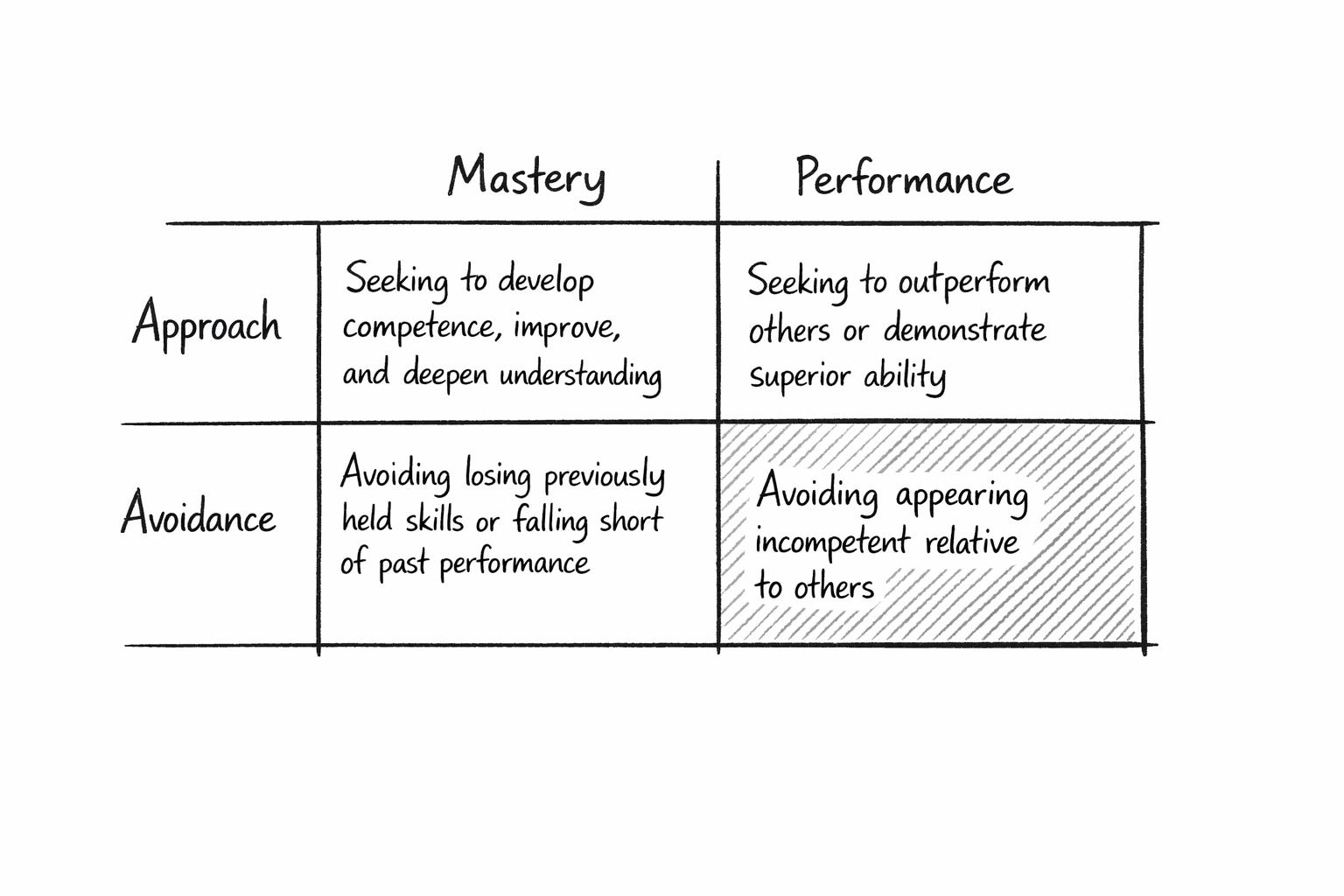
Mastery-approach goals involve seeking to develop competence, improve on previous performance, and deepen understanding. The research consistently finds this to be the most adaptive orientation: people pursuing mastery-approach goals tend to use deeper learning strategies, seek more feedback, persist longer when things become difficult, and report greater intrinsic motivation (Payne, Youngcourt and Beaubien, 2007).
Mastery-avoidance goals are less frequently discussed but worth knowing about. They involve the desire not to lose previously held skills or knowledge, not to regress, and not to fall short of one’s own previous standard. This orientation tends to associate with perfectionism and anxiety about decline, and the research on its effects is less settled than for the other three (Baranik, Stanley, Bynum and Lance, 2010).
Performance-approach goals involve seeking to outperform others or demonstrate superior ability relative to peers. The effects here are mixed. In some contexts, where tasks are straightforward and outcomes are clearly measured, performance-approach goals can associate with higher short-term achievement. The same orientation, however, tends to associate with increased anxiety, reduced cooperation, and a reluctance to seek help or admit uncertainty (Hulleman, Schrager, Bodmann and Harackiewicz, 2010).
Performance-avoidance goals are where the most consistently problematic pattern sits. People pursuing performance-avoidance goals are motivated primarily by not appearing incompetent in front of others. They tend to avoid challenges that risk exposing weakness, use surface-level strategies to get through assessments rather than building genuine understanding, disengage when things become difficult, and may engage in self-handicapping behaviour to have an excuse ready if things go wrong. The research on this orientation is about as clear as motivational psychology gets (Payne, Youngcourt and Beaubien, 2007).
One important nuance worth holding onto: goal orientations are not fixed personality traits. Research shows they have a dispositional component, meaning people do carry tendencies with them, but a substantial proportion of the variation in which orientation someone adopts is situational (Button, Mathieu and Zajac, 1996). The environment shapes which orientation becomes active, often quite powerfully, and that is what makes this theory so relevant to learning design.
The evidence-informed practice conference is an opportunity to learn from scientists, researchers, practitioners, and leaders actively using evidence-informed approaches to drive organisational performance.
Speakers include: Matthew Richter, Amy Brann, Sukhvinder Pabial, Sara L. Farwell, Maciej Zatonski, Kurt Ewald Lindley, Laura Watkin, Jospeh Devlin, Elena Marie Ivanushkina, and more to be confirmed soon!
As a reader, you get 25% off a ticket. To learn more and book your place at this community-focused sales-free event, click the banner below.

A brief note on growth mindset
Goal Orientation Theory shares some intellectual territory with the concept of growth mindset, and the two are frequently conflated, particularly in vendor materials. They are related but distinct.
Growth mindset, as popularly understood, is a claim about belief: specifically, the belief that intelligence and ability are malleable rather than fixed. Goal orientation is a framework about the goals people pursue and the motivational processes those goals set in motion. Mindset sits upstream of goal orientation in the causal chain; it may influence which goals someone tends toward, but the relationship between the two is weaker than the popular framing suggests, with mindset explaining only a small fraction of the variation in goal orientation (Burnette, O’Boyle, VanEpps, Pollack and Finkel, 2013).
Growth mindset as a basis for workplace training programmes is, it should be said, broadly misunderstood and misapplied. The evidence for growth mindset interventions producing lasting, measurable change in adult workplace behaviour is thin, and the concept has been substantially simplified in its journey from academic psychology into the training catalogue. Goal Orientation Theory, by contrast, carries a considerably more robust empirical base in organisational contexts, and offers more actionable structural guidance for those who design learning environments.
What the evidence says
The evidence base for Goal Orientation Theory is extensive and, by the standards of motivational psychology, fairly solid, though it is worth noting that this is an area with limited certainty..
The most comprehensive examination of the research came from Payne, Youngcourt and Beaubien (2007), who synthesised findings across the literature and found that a mastery or learning goal orientation consistently predicted positive outcomes including deeper learning strategies, higher self-confidence, greater feedback-seeking behaviour, and stronger job performance, and that it did so over and above other individual differences such as cognitive ability and personality. Knowing something about an employee’s goal orientation tells you something about their likely learning and performance that the standard selection tools would not have revealed.
For those with a specific interest in whether training translates back into the workplace, Gegenfurtner’s (2013) analysis of thirty years of research found that a mastery goal orientation showed a substantial positive relationship with training transfer. In plain terms, people who approach training with a mastery orientation are considerably more likely to apply what they have learned when they return to work. A performance-approach orientation showed almost no relationship with transfer, and performance-avoidance was negatively associated with it. If the aim of a training programme is for learning to change what people do, goal orientation is one of the more important variables to understand.
Now let’s look at where the evidence is more uncertain: performance-approach goals remain contested. Whether they are helpful or harmful depends significantly on how they are measured and which outcomes are prioritised. A performance-approach orientation might associate with higher assessment scores while simultaneously associating with reduced willingness to collaborate or seek help from colleagues, which makes a simple verdict difficult.
Effect sizes across the field are generally modest by the conventions used in psychological research, meaning the relationships are real and consistent but not enormous in scale. Most studies also rely on people self-reporting their own goal orientations rather than independently observed behaviour, which introduces some limitation. Cultural generalisability is a further consideration worth noting: most of the foundational research was conducted in Western, primarily American, contexts, and there is evidence that the effects of different goal orientations vary across cultural settings (Khajavy, Bardach, Hamedi and Lüftenegger, 2018). L&D professionals working across geographically or culturally diverse organisations should hold the specific findings with appropriate flexibility.
What this means for how we design learning
Designing environments that make mastery salient
Carole Ames’ TARGET framework (1992) provides the most empirically grounded starting point for designing learning environments that activate mastery orientation. TARGET covers six structural elements:
Task
Authority
Recognition
Grouping
Evaluation
Time
Longitudinal research by Lüftenegger and colleagues (2014) provided evidence that the full framework, applied consistently, causally predicts which goal orientations learners adopt. The structural elements of the environment shape motivational outcomes in a predictable direction.
Translated into our work, each element raises a set of design questions worth taking seriously.
The nature of the task matters: learning activities that are varied, moderately challenging, and framed around developing understanding tend to activate mastery orientation more reliably than tasks designed to demonstrate what someone already knows.
Authority refers to the degree of learner choice and control available; people who have meaningful agency over their learning path are more likely to sustain mastery orientation.
Recognition should be based on individual progress relative to previous performance rather than on comparison with peers, with private acknowledgement of growth supporting mastery and public ranking tending to activate performance orientation instead.
Grouping practices that encourage collaboration and mutual support shift the environment toward mastery, while grouping that makes individual performance visible and competitive activates performance orientation.
Evaluation criteria that reference personal improvement over time support mastery; criteria that rank people against each other or against a fixed external threshold activate performance orientation.
Time refers to whether the structure of a programme allows for reflection, iteration, and depth, or whether it pressures people into surface coverage in the service of completion metrics.
Many workplace learning programmes, designed quickly and under resource pressure, default toward performance activation. Pass/fail assessments with a single fixed standard, cohort completion reports shared with line managers, and ranked performance metrics all signal that the purpose of the learning is to demonstrate competence rather than develop it. That signal shapes how people engage with the material.
Designing feedback that supports learning
The research on feedback and goal orientation is some of the most practically useful in the field, and some of the most counterintuitive.
Kluger and DeNisi’s (1996) meta-analysis of feedback interventions, drawing on more than 600 separate sets of findings, found that while feedback improved performance on average, more than a third of the time it made performance worse. The determining variable was where the feedback directed attention: feedback that drew attention toward the person’s self-image tended to activate performance-avoidance orientation and reduce subsequent engagement; feedback focused on the specific details of the task provided diagnostic information that supported mastery orientation and learning.
Mueller and Dweck (1998) demonstrated this distinction clearly: children told “you must be very clever” after success adopted performance goals, avoided more challenging subsequent tasks, and showed reduced persistence when they encountered difficulty; children told “you must have worked really hard” adopted learning goals and showed the opposite pattern across each of those measures. Ability-focused praise, of the sort that feels encouraging in the moment, signals that the point of the exercise is to demonstrate capability, which makes subsequent difficulty feel threatening. Process-focused, task-specific feedback signals that the point is development, and keeps mastery orientation active.
VandeWalle and Cummings (1997) added a further dimension: learning-oriented employees actively seek feedback because they treat it as useful information, while performance-avoidance-oriented employees avoid it because it represents a potential threat to how they are perceived. This means the employees most likely to benefit from feedback are the least likely to receive it in environments that have activated performance-avoidance orientation.
Designing feedback systems that are safe to engage with, where seeking feedback is normalised and where feedback is delivered privately with reference to personal progress rather than comparative standing, can shift that pattern.
Managers as climate architects
Perhaps the most important finding from the organisational strand of Goal Orientation Theory research is that the motivational climate of a team or department is shaped primarily by everyday management behaviour, and not by formal learning programmes.
Nerstad, Roberts and Richardsen (2013) adapted the motivational climate framework from sport psychology into workplace contexts and built validated tools for measuring it in organisations. The subsequent research programme demonstrated that employees who perceive a mastery climate, one in which development is valued, effort is recognised, and mistakes are treated as learning opportunities, show significantly higher levels of knowledge sharing, trust, and adaptive performance than those who perceive a performance climate dominated by comparison, ranking, and the fear of appearing incompetent (Nerstad, Searle, Caniëls and Dysvik, 2018).
A particularly important finding for organisations thinking about culture: the relationship between mastery climate and intrinsic motivation appears to be undermined when a strong performance climate is present simultaneously (Ntoumanis and Biddle, 1999). The two climates do not add together; they interact in a way that can cancel out the benefits of the mastery-oriented elements. This has significant implications for organisations that attempt to introduce mastery-oriented learning cultures while maintaining performance management structures built on forced distribution, stack ranking, or comparative grading. The structural signals will tend to dominate.
More recently, Schelp, Bipp, Gado and Daumiller (2025) found specifically that supervisor appraisal behaviour, and in particular whether supervisors use self-referenced norms in feedback conversations and handle errors constructively rather than punitively, predicts the goal orientation employees adopt in their work. Managers are continuously broadcasting information about what the environment values, and employees are continuously reading and responding to that broadcast. A manager trained to give development-focused feedback within a performance management system built on quarterly ranking tables is working against significant structural friction, which is a design problem, not a skill problem.
Putting it together
Goal Orientation Theory doesn’t ask L&D professionals to change individuals; it asks us to think carefully about the signals that learning environments, feedback systems, and management structures send to the people inside them. The research is consistent on this point: mastery-oriented environments tend to produce mastery-oriented behaviour, and performance-oriented environments tend to produce performance-oriented behaviour, regardless of what individuals’ underlying dispositions might be.
The practical question worth sitting with isn’t whether your employees have the right attitude toward learning. The question is whether your assessment design, your feedback practices, and your recognition systems are telling people that learning is about development or about demonstration. More often than not, that message is being communicated by the structure of what has been built, quietly and continuously, well before any facilitator opens their mouth.
Lots of interesting ideas here...and specifically how we could engineer better learning transfer.