
Tiredness and Performance

I came home from LearnTec in Karlsruhe last week with a notebook full of half-thoughts, a head full of half-finished conversations, and the depressing realisation that I’d missed both the Saturday and Sunday releases that anchor my publication week. The intention had been there each evening. The laptop had been opened. The cursor blinked at me with what I assumed was either pity or mild contempt, and I shut it again, or fell asleep inspite of it;s unending blinking… see below.
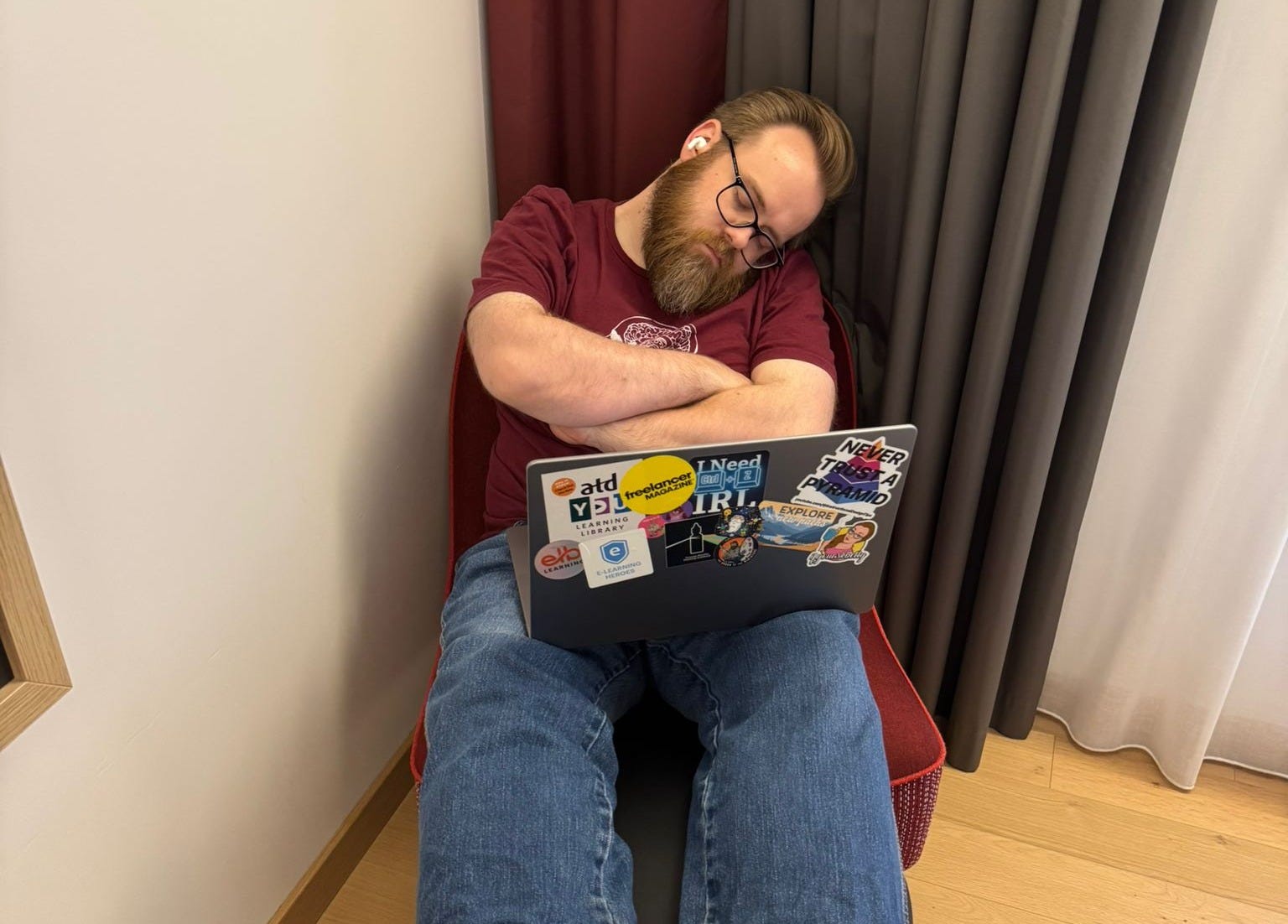
This isn’t a confession piece, though, or if it is, it’s one where the confession quickly becomes a question. People are tired all the time. We all know they are. The HR conversations about wellbeing, the L&D conversations about engagement, the line management conversations about productivity, they all circle this. Tiredness may be doing more to undermine how our employees work and learn than most of the things we spend our budgets trying to fix.
What tiredness is doing to the people we work with
Stay awake for seventeen hours and performance on tasks needing attention, reaction time, and basic motor control sits roughly at the level of someone with a blood alcohol concentration of 0.05 per cent. Stay awake for twenty-four hours and you’re at 0.10 per cent, which is over the drink-drive limit pretty much everywhere (Dawson and Reid, 1997; Williamson and Feyer, 2000).
Most workplaces have clear, well-policed rules about turning up drunk to work. The same workplaces will routinely schedule international travel, sandwich a 21:00 client dinner between two early-start days, or send an email at 23:00 expecting a thoughtful reply by 08:00, and call the resulting state of their employees something more flattering. Resilience, perhaps; commitment, even.
What’s going on inside a tired head is more interesting than the resigned “I’m shattered” suggests. The prefrontal cortex, the bit of brain you’re using right now to follow this sentence and to inhibit the impulse to check your phone, starts to power down. Connectivity between the prefrontal cortex and the amygdala, the small structure that handles emotional reactivity, weakens. Emotional responses become larger, top-down regulation of those responses becomes smaller, and patience for ambiguity or other people’s small errors collapses (Yoo et al., 2007).
The hippocampus, where new memories begin their life, starts to behave like a saturated sponge. A night of sleep deprivation before learning reduces the hippocampus’s ability to encode new information by something close to 40% (Yoo et al., 2007).
Tired people also make riskier choices, and, probably more worryingly, don’t notice they’re doing it. Self-rated performance stays roughly stable as objective performance drifts (Van Dongen et al., 2003). The tired version of us is convinced it’s fine; but it isn’t.
Why this should bother anyone in L&D
Sleep does three things to memory.
Sleep before learning prepares the brain to take new information in. Sleep after learning is when much of that information is consolidated and integrated with what you already know. Sleep is also where creative connections between unrelated ideas tend to get made; people who’ve slept after exposure to a problem are more than twice as likely to discover a non-obvious solution to it (Wagner et al., 2004). Pre-learning sleep loss impairs memory more than post-learning sleep loss does, but both matter (Newbury et al., 2021).
A training day delivered to participants who arrived tired loses encoding capacity. A training day followed by another short night loses consolidation. A design sprint or strategy session held across two intensive days with limited sleep in between loses the integrative work that the sleep itself was meant to do. None of these losses appear on the post-training feedback form. They show up later, as the application that didn’t happen, the skill that didn’t stick, the behaviour change that didn’t materialise, and the line manager wondering whether the training was worth the spend.
We worry endlessly about modality, engagement scores, or whether the activity was active enough or the multimedia rich enough, and most of these things matter rather less than whether the people in the room had slept. We can spend significant money optimising a training experience for an audience whose brains have been pre-degraded by the conditions of the organisation paying for the training.
Join me and the one and only Cathy Hoy as we explore why leadership development has become L&D’s No. 1 focus in 2026, according to the first SME L&D survey. We’ll also look at what great leadership development training looks like today.
The workplace is doing a lot of the producing
When we take a really honest look at the situation, we see that the workplace is responsible for a great deal of the tiredness it then tries to mitigate. Long hours, mobile devices that don’t sleep, evening emails, business travel scheduled to maximise meetings and minimise recovery, and shift patterns that work against the body’s clock rather than with it.
The average UK adult gets three nights of decent sleep a week (Mental Health Foundation, 2025). The CIPD’s most recent figures put average sickness absence at the highest level in over a decade, with much of the rise attributable to stress, anxiety, and mental ill-health (Chartered Institute of Personnel and Development, 2023). RAND Europe put the annual UK economic cost of insufficient sleep at around £40B, or roughly 2% of GDP (Hafner et al., 2017).
What L&D, HR, and line managers can do about it
Most of the popular individual-level wellbeing interventions, the resilience training, the mindfulness apps, the cheery webinar at lunch, show little effect when examined rigorously (Fleming, 2024). The interventions that move sleep tend to operate higher up the system, on workload, supervision, and scheduling. The list below is roughly in the order of observed impact.
Stop scheduling training as if tiredness isn’t real
Build training around when brains can do the work. Avoid the post-lunch slump for deep cognitive work; that’s the lowest point of the circadian dip for most adults. Don’t schedule intensive new sessions for the second day of an off-site; everyone’s already running on insufficient sleep by then. Build twenty-minute breaks rather than five, and put them between conceptually demanding sessions rather than at convenient hourly intervals. Don’t introduce substantive new content after 16:00, and don’t ask people to apply complex new skills the morning after a late-finishing evening session. If your training calendar regularly violates these patterns, ask how much of your training budget is being spent on memories that won’t form.
Treat travel and shift handovers as training disqualifiers
If somebody has flown in the night before, has come off a night shift, has been on the road three days running, they shouldn’t be in your training room the next morning. Make it acceptable, and expected, to reschedule. Build that flexibility into your booking system; a same-week reschedule with no penalty is the operational design that works. The HSE’s HSG256 guidance on shift work is the foundation document for getting shift design less wrong, and most organisations running shifts have never read it (Health and Safety Executive, 2006). Read it. Apply it. Audit your current rotas against it. Where you find permanent night shifts, backward rotations, sub-07:00 starts that aren’t operationally required, or runs of seven or more consecutive shifts, fix them in that order.
Audit your meeting and email norms before you audit your training
A norm of 22:00 emails is a norm of next-day cognitive impairment, and no amount of clever instructional design will compensate for an organisation operating at the equivalent of mild intoxication. Look at the hours during which your senior leaders send messages, whether replies are expected by morning, and whether anyone has ever been promoted for being seen to work late. The single most useful thing many L&D and HR teams could do this year is sit down with their leadership team and have an awkward conversation about what their email behaviour is teaching everyone else. If that conversation can’t happen, the next-best move is a written norm: no internal email outside contracted hours with delay-send used by default; meeting-free blocks during the working day; and a clear statement that out-of-hours messages don’t require a same-day reply.
Train line managers to protect sleep, not to recommend yoga
Supervisor support for sleep, the willingness of a manager to say “push the deliverable, you’ve had three brutal weeks” rather than “have you tried the meditation app”, produces measurable improvements in employee sleep and wellbeing (Hammer et al., 2021). This is a skill, it can be taught, and it costs less than the wellbeing platform subscriptions most organisations are paying for. Equip managers with three things: the vocabulary to ask about sleep without it sounding intrusive, the authority to redistribute work when somebody is running on empty, and a clear set of organisational permissions that back them up when they do.
Take sleep disorders seriously
A sizable number of the people who turn up to work tired aren’t tired because they’re staying up watching Netflix. They have obstructive sleep apnoea or another underdiagnosed sleep disorder, and most don’t know it. For safety-critical roles in particular, this is a conversation to have with your occupational health provider; for everyone else, the simplest first step is including a validated screening tool such as the STOP-BANG questionnaire in your routine health checks, with clear referral pathways to a sleep clinic for those who score high. Treatment of sleep apnoea pays for itself comfortably in recovered productivity, and that’s before counting the safety benefit.
Stop framing tiredness as a personal failing
Change the language. Tiredness in your workforce is not, on the whole, a character flaw, a discipline gap, or an opportunity for a sleep-hygiene leaflet. It’s a signal about workload, scheduling, and leadership behaviour. When somebody mentions they’re exhausted, the first response from a manager or HR business partner shouldn’t be “have you tried” anything; it should be “tell me what’s making you tired”. That conversation produces useful information.
A short note before I shut the laptop
The strange thing about writing this piece is that I knew most of it before I went to Karlsruhe. I’ve read this material and quote some of it in workshops. I still managed to lose 4 days of writing to a conference schedule.
This is the trap most of our employees are in. They know they’re tired, and they know it’s affecting them. They’re not, on the whole, choosing it freely; they’re navigating workplace expectations that make adequate sleep difficult, and then turning up to the training we put on to help them perform better. Whether that training works or not is decided long before they walk in.
Tiredness is a performance problem, a learning problem, a safety problem, and a leadership problem, and it sits much closer to the centre of our work than we’ve tended to admit. It deserves a place on the agenda alongside skills, capability, and culture.
References
Chartered Institute of Personnel and Development (2023) Health and wellbeing at work 2023. London: CIPD.
Dawson, D. and Reid, K. (1997) ‘Fatigue, alcohol and performance impairment’, Nature, 388(6639), p. 235.
Fleming, W.J. (2024) ‘Employee well-being outcomes from individual-level mental health interventions: cross-sectional evidence from the United Kingdom’, Industrial Relations Journal, 55(2), pp. 162-182.
Hafner, M., Stepanek, M., Taylor, J., Troxel, W.M. and Van Stolk, C. (2017) ‘Why sleep matters: the economic costs of insufficient sleep: a cross-country comparative analysis’, RAND Health Quarterly, 6(4), p. 11.
Hammer, L.B., Brady, J.M., Brossoit, R.M., Mohr, C.D., Bodner, T.E., Crain, T.L. and Brockwood, K.J. (2021) ‘Effects of a Total Worker Health leadership intervention on employee well-being and functional impairment’, Journal of Occupational Health Psychology, 26(6), pp. 582-598.
Health and Safety Executive (2006) Managing shift work: health and safety guidance (HSG256). London: HSE Books.
Mental Health Foundation (2025) Restless Britain: average UK adult has only three days a week with good quality sleep.
Newbury, C.R., Crowley, R., Rastle, K. and Tamminen, J. (2021) ‘Sleep deprivation and memory: meta-analytic reviews of studies on sleep deprivation before and after learning’, Psychological Bulletin, 147(11), pp. 1215-1240.
Van Dongen, H.P.A., Maislin, G., Mullington, J.M. and Dinges, D.F. (2003) ‘The cumulative cost of additional wakefulness: dose-response effects on neurobehavioral functions and sleep physiology from chronic sleep restriction and total sleep deprivation’, Sleep, 26(2), pp. 117-126.
Wagner, U., Gais, S., Haider, H., Verleger, R. and Born, J. (2004) ‘Sleep inspires insight’, Nature, 427(6972), pp. 352-355.
Williamson, A.M. and Feyer, A.-M. (2000) ‘Moderate sleep deprivation produces impairments in cognitive and motor performance equivalent to legally prescribed levels of alcohol intoxication’, Occupational and Environmental Medicine, 57(10), pp. 649-655.
Yoo, S.-S., Hu, P.T., Gujar, N., Jolesz, F.A. and Walker, M.P. (2007a) ‘A deficit in the ability to form new human memories without sleep’, Nature Neuroscience, 10(3), pp. 385-392.
Yoo, S.-S., Gujar, N., Hu, P., Jolesz, F.A. and Walker, M.P. (2007b) ‘The human emotional brain without sleep: a prefrontal amygdala disconnect’, Current Biology, 17(20), pp. R877-R878.
Great post Tom. You cannot out eat or out think poor sleep habits. Tiredness is often a feeling (emotion) or symptom. And once we are out of cognitive reserve, we'll still be able to function at our defaults. It's not like tiredness or fatigue of a muscle during strength training. I would encourage people to apply spoon theory for themselves and then extend it into how learning is designed and implemented.